Red Light Therapy for Skin Health & Scar Support in Campbellfield
Understand how amber, red and near-infrared Photobiomodulation interact with different layers of the skin and the biological processes involved in skin health, collagen and tissue remodelling.
What would you like to understand?
Skin Health & Collagen
How red and near-infrared light are studied in relation to skin cells and collagen.
Explore →Epidermis & Dermis
What sits beneath the surface, and how different wavelengths relate to each layer.
Explore →Scars & Post-Surgical Recovery
How scars form and remodel, and where PBM is being researched.
Explore →Post-Treatment Recovery
Using red light around PRP, PRF, skin needling and laser.
Explore →Skin-focused red light at My BioHealth is the same 20-minute Red Light Therapy session, in the same full-body LED bed, that clients book for recovery and wellness. This page covers the skin, collagen and scar questions that matter when your goal is your skin. Explore Full-Body Red Light Therapy & Photobiomodulation →
Have a specific skin or scar goal? You’re welcome to discuss it with our team when you arrive so we can understand what you’re hoping to support.
How Red Light Therapy Interacts With Skin
Skin is biologically active tissue. Photobiomodulation research examines effects involving keratinocytes, fibroblasts, mitochondria, inflammatory signalling, collagen-related processes, the extracellular matrix and tissue repair.
Because fibroblasts contribute to collagen and extracellular-matrix production, they are an important focus of photobiomodulation research involving skin. Some clinical studies report changes in skin appearance, but results depend on wavelength, dose, device and schedule, and no particular collagen change can be promised. Individual responses vary.
Red Light Doesn’t Stop at What You See on the Surface

Epidermis
The outer layer of skin. It contains keratinocytes and is important for barrier function, cell turnover, wound closure and protection.
Dermis
The layer beneath, containing fibroblasts, collagen, elastin, the extracellular matrix, blood vessels and nerves. Because this is where collagen is produced and organised, the dermis is central to any discussion of skin quality and scar remodelling.
Subcutaneous and deeper tissue
Below the dermis. Longer wavelengths such as near-infrared generally penetrate more deeply than shorter visible wavelengths, though intensity fades gradually and there is no single fixed depth.
What Do 589, 630, 660 and 850 nm Mean for Skin?
- 589 nm, amber: visible amber light, relevant to selected superficial skin-focused applications.
- 630 nm, red: visible red light frequently used in skin-oriented photobiomodulation research.
- 660 nm, red: visible red light commonly studied around skin, fibroblast and tissue-recovery processes.
- 850 nm, near-infrared: invisible light that generally penetrates deeper through tissue than visible red wavelengths.
Wavelength is only one variable. Dose, irradiance, duration, frequency, positioning and individual biology also influence the biological response. See the wavelength penetration diagram →
Red Light Therapy for Scars & Post-Surgical Tissue Recovery
A scar is not simply a mark sitting on the skin. It represents an ongoing biological repair and remodelling process within the tissue, which generally moves through overlapping stages:
- Inflammation: the body’s first response to injury, clearing debris and signalling repair.
- Proliferation: new tissue and small blood vessels form, and the wound closes.
- Collagen deposition: fibroblasts lay down new collagen to rebuild strength.
- Extracellular-matrix organisation: collagen fibres and surrounding matrix are gradually arranged.
- Scar remodelling: collagen is reorganised and matured, a process that can continue for many months.
Fibroblasts are central to this process because they produce and reorganise collagen. Red and near-infrared Photobiomodulation are being researched as supportive modalities within wound and scar-remodelling pathways, and may support biological processes involved in tissue recovery and scar remodelling. Red Light Therapy does not remove scars.

When Should Red Light Therapy Start After Surgery?
There is no universal “day X” for everyone. Timing depends on the type of surgery, wound closure, dressings, any infection or complications, your surgeon’s instructions, medications, the location of the surgery and your individual health history.
Your surgeon’s wound-care and post-operative instructions take priority. Red Light Therapy should not replace surgical follow-up or medical scar management. Please speak with your surgeon first, and tell us about your procedure when you book. Medical clearance may be required.
Looking for More Advanced Scar Treatment Options?
Red Light Therapy may form one part of a scar-support plan, but some scars may benefit from a different or more targeted approach.

Depending on the type, age and structure of the scar, My BioHealth also offers advanced skin treatments including fractional CO₂ resurfacing, skin needling and other practitioner-led skin options. Which option may suit depends on the scar’s type, age, depth and texture, your skin condition, treatment history, goals and suitability. No single treatment suits every scar.
If you’re unsure which approach may suit your concern, you’re welcome to enquire about a skin consultation so we can discuss the scar, your goals and the treatment options available. You can also start with our Skin Concerns Tool.
Can Red Light Be Used Around Other Skin Treatments?
Photobiomodulation may be incorporated into selected skin-treatment plans, but timing depends on the treatment performed, the condition of the skin and individual suitability. There is no blanket rule, so your nurse plans the sequence with you.
Treatments it may be planned around include PRP and PRF, skin needling (microneedling) and CO2 laser resurfacing, as well as selected other laser treatments.
What About Red Light Therapy for Acne Scars?
“Acne scarring” covers several different things: active acne, post-inflammatory redness, pigmentation, and structural scars such as rolling, boxcar, ice-pick and hypertrophic (raised) scars.
Red Light Therapy may have a supportive role within a broader skin plan, but structural acne scarring may require treatments designed specifically to remodel scar architecture. Photobiomodulation does not resurface established structural scars.
Try the Skin Concerns Tool → Skin Needling → CO2 Laser →
Does Red Light Therapy Damage the Skin to Stimulate Collagen?
No intentional controlled injury is required for Photobiomodulation. That is the key difference from microneedling, fractional CO2 and other ablative or resurfacing treatments.
Photobiomodulation
Light-driven biological signalling, without intentional skin injury.
Resurfacing & needling
Controlled injury followed by the skin’s wound-healing response.
Neither approach is universally superior. They serve different purposes, and your nurse can explain which suits your skin goal.
Is Red Light Therapy the Same as an Infrared Sauna?
No. An infrared sauna relies significantly on thermal effects. Photobiomodulation uses selected wavelengths and treatment parameters with the aim of influencing cellular signalling. Mild warmth may occur during PBM, but heating tissue is not the primary mechanism being targeted.
What a Skin Session Is Like
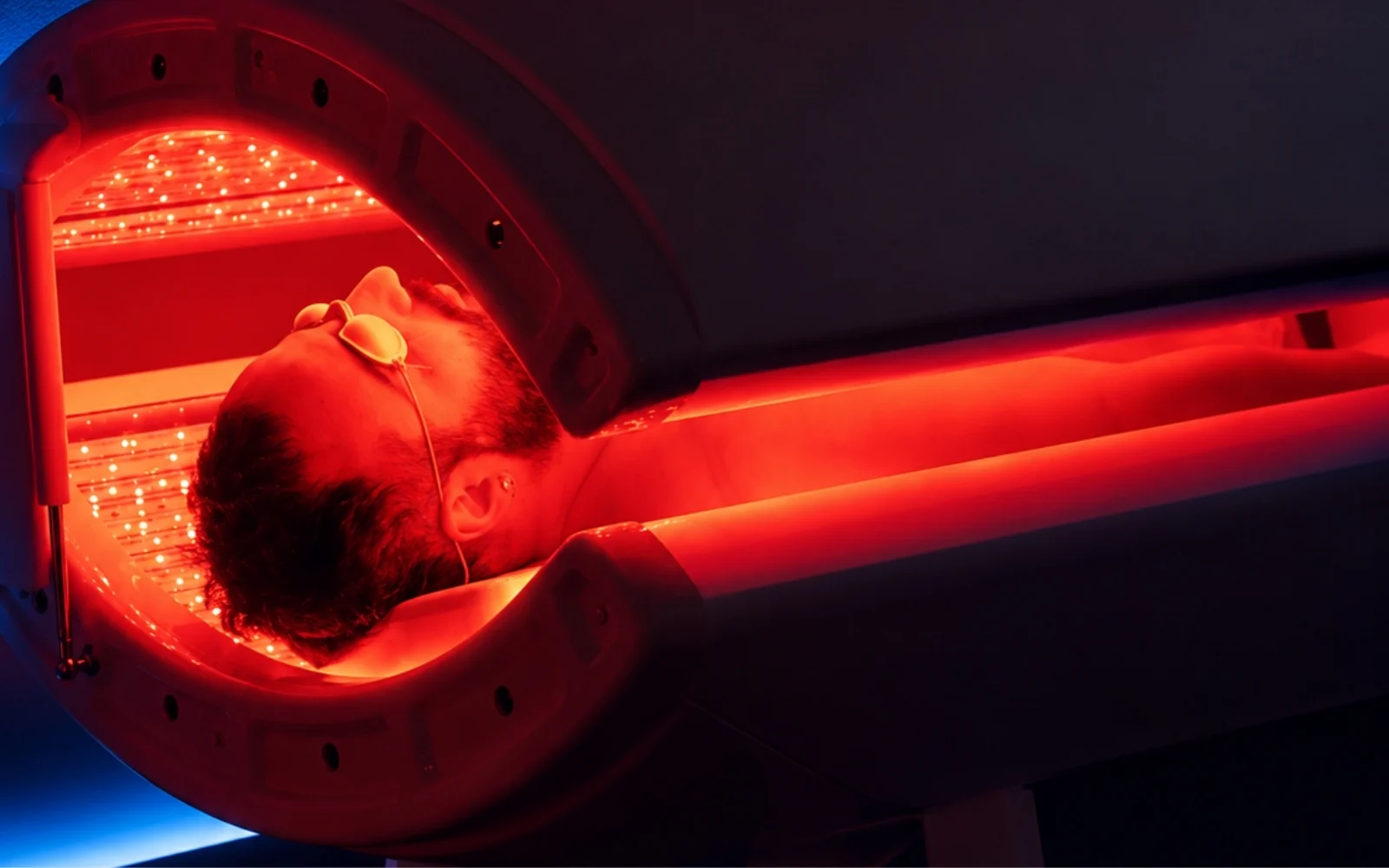
Protective eyewear is provided and must be worn. The intended treatment area should be uncovered for effective light exposure; underwear may remain on, and your privacy is maintained throughout.
Sessions and pricing: $59 for a 20-minute session. Ask about our 5 session pack ($266) or 10 session pack ($502) if you are planning regular sessions. These are the same Red Light Therapy sessions and prices as our full-body service, booked directly online.
Who May Consider It?
Skin quality
Skin-quality support and collagen-focused skin plans.
Redness & recovery
Visible redness support and general skin recovery.
After treatments
Post-procedure recovery and appropriate scar-support plans.
Non-invasive
People seeking a skin modality without needles or intentional injury.
Suitability varies, and you’re welcome to discuss your goals with our team when you arrive. Red Light Therapy does not replace medical assessment of new, changing or unexplained skin concerns.
Before Your Session & Safety
- Arrive with clean skin. No makeup, lotion, oil or sunscreen on the areas being treated.
- Remove jewellery and watches.
- Protective eyewear is provided and must be worn.
This service may not be suitable if:
- You take medication that increases light sensitivity, such as some antibiotics, isotretinoin or St John’s Wort.
- You have skin cancer, melanoma or an undiagnosed lesion in the treatment area.
- You have photosensitive epilepsy.
- You are pregnant. Please discuss with your practitioner first.
- You have had a corticosteroid injection in the area within the last week.
Common questions
Research has investigated how red and near-infrared light affect fibroblasts, the cells that produce collagen, and some clinical studies report changes in skin appearance. Results depend on the wavelength, dose, device and schedule used, so we cannot promise a particular collagen change for any individual. Individual responses vary.
Red and near-infrared photobiomodulation are being researched as supportive modalities in wound healing and scar remodelling, and may support biological processes involved in tissue recovery. It does not remove scars and does not replace your surgeon's scar management. Suitability is assessed before treatment, medical clearance may be required, and some scars may suit more advanced skin treatments.
There is no universal starting day. Timing depends on the type of surgery, wound closure, dressings, any infection or complications, medications, the location and your health history. Your surgeon's wound-care and post-operative instructions take priority, so please speak with them first.
Visible red wavelengths interact mainly with the epidermis and dermis, and near-infrared light generally travels further. Light intensity decreases gradually as it passes through tissue, so there is no single fixed depth. Actual delivery depends on the individual, body area, device output, positioning and dose.
630 nm and 660 nm are visible red wavelengths commonly used in skin-focused photobiomodulation research. 850 nm is invisible near-infrared light that generally penetrates further through tissue. Wavelength is only one variable: dose, irradiance, duration, frequency and positioning also shape the response.
No needles or intentional skin injury are involved. Most people notice bright light and gentle warmth. Temporary redness or sensitivity can occasionally occur, and protective eyewear is provided and must be worn.
20 minutes, in the same full-body bed used for all our Red Light Therapy sessions.
There is no fixed number. Skin-focused research uses a range of schedules, often a course over several weeks. You are welcome to discuss a plan based on your goals, skin and response with our team when you attend. Individual responses vary.
Photobiomodulation may be incorporated into selected PRP or PRF treatment plans. Timing depends on the treatment performed, the condition of your skin and your suitability, so your nurse will plan the sequence with you rather than applying a blanket rule.
It may be considered as part of a skin-needling plan, but timing depends on how your skin has responded to needling and on individual suitability. Your nurse will advise when a session is appropriate.
No. An infrared sauna works mainly through heat. Photobiomodulation uses selected wavelengths and treatment parameters with the aim of influencing cellular signalling. Mild warmth may occur during PBM, but heating tissue is not the primary mechanism being targeted.
No. Red Light Therapy may have a supportive role within a broader skin plan, but it does not resurface established acne scars. Rolling, boxcar, ice-pick and raised scars may need treatments designed to remodel scar structure, such as skin needling or CO2 laser, which are assessed at consultation.
PBM does not rely on targeting melanin in the same way as many aesthetic lasers, but suitability and dosing still matter and are checked before treatment. If you have any specific skin concerns or conditions, mention them to our team before your first session.
Want to Understand the Science?
Understanding Photobiomodulation
Mitochondria, photoacceptors, dose and the limits of the research.
Read the science →My BioHealth Evidence Hub
Published studies relating to the services we offer, with links to each source.
See the evidence →Explore Skin Treatments
PRP and PRF, skin needling, CO2 laser and other Skin & Aesthetics services.
View skin services →Red Light Therapy for Skin in Campbellfield
My BioHealth is a nurse-led clinic in Campbellfield, in Melbourne’s northern suburbs. Clients visit for skin-focused red light from Broadmeadows, Craigieburn, Roxburgh Park, Fawkner, Glenroy, Greenvale and surrounding areas. All visits are by appointment only.