

Campbellfield · Melbourne’s north · Nurse-led clinic
Full-Body Red Light Therapy in Campbellfield, Melbourne
One full-body session, different personal goals.
You might be exploring Red Light Therapy for skin texture and fine lines, or researching how it fits into an exercise and recovery routine. At My BioHealth in Campbellfield, our full-body LED bed combines amber, red and near-infrared light in a private, 20-minute appointment. Your goal helps guide the conversation about suitability, settings and realistic expectations.
Protective eyewear is provided and must be worn.
Before your sessionSafety and suitability
What brings you to Red Light Therapy?
Skin texture, fine lines and changing firmness
If your interest is skin rejuvenation, explore how LED light therapy is studied in relation to skin appearance, collagen and elastin. We explain the evidence and what is relevant to your skin goals.
Explore Red Light Therapy for skin, collagen and fine-line questions
Exercise and recovery routines
You may be researching red and near-infrared light around training, muscle soreness or everyday physical load. Evidence differs between localised devices and full-body beds, so we discuss realistic expectations for this appointment.
YOUR APPOINTMENT
Options, pricing & booking
Session & package options
Single session
$59
- Session
- 20 minutes
- Sessions
- 1
GET TO KNOW YOUR TREATMENT
The details, at your pace
Your experience, preparation and next steps.
Why choose Red Light Therapy at My BioHealth?
A clear, simple appointment
See the duration, wavelengths and prices before you book. The team explains the bed, your session and preparation so you know what to expect.
Full-body light exposure
Our bed exposes large areas of the body in the same session. Lie back and rest while selected amber, red and near-infrared wavelengths are delivered.
Privacy and guidance
Your privacy is maintained throughout. We explain how to prepare the intended treatment areas and provide protective eyewear.
One My BioHealth environment
Explore Red Light Therapy as a standalone appointment or as part of your wider wellness and recovery routine. Skin, hair and recovery services are available under the same My BioHealth brand.
What happens during your session?
1. Arrive and be guided
The team explains the bed, checks relevant suitability information and answers your questions. Protective eyewear is provided.
2. Prepare the treatment area
The intended area should be uncovered for light exposure. Underwear can remain on, and your privacy is maintained. Arrive with clean skin and remove jewellery and watches.
3. Lie back for 20 minutes
Rest in the full-body LED bed while the session runs. You may notice bright light and gentle warmth. Red Light Therapy uses no needles and does not intentionally injure, burn or remove skin.
4. Know your next step
Minimal to no downtime is expected, although temporary redness or sensitivity can occur. Ask the team about a return visit, pack or ongoing routine if you would like guidance.
More about your appointment
What brings you to Red Light Therapy?
You can book directly if you already know the session you want. If you are exploring, choose the information most relevant to you.
Muscle recovery and training routines
People who train regularly often explore PBM alongside other recovery habits. Research looks at muscle function, fatigue and exercise recovery, with results depending on the device, dose, timing and people studied.
Localised PBM and full-body beds have different evidence bases. The deeper research section below explains that distinction.
Everyday physical load
Work, exercise and repetitive movement can leave you feeling physically fatigued. A non-invasive full-body session offers time to rest as you explore your recovery routine.
Persistent, worsening or unexplained pain needs appropriate assessment. Your session does not replace diagnosis, physiotherapy or medical injury management.
Wellness and cellular science
PBM research examines how specific light wavelengths interact with cellular signalling. If you are curious about ATP and mitochondrial pathways, explore Mitochondria and Cellular Energy.
Skin, collagen and elastin questions
For skin texture, fine lines, elasticity and collagen-related research, explore Red Light Therapy for skin, collagen and elastin. If your question concerns a procedure or scar, read our skin and scar information and discuss timing with your treating practitioner.
This is the same Red Light Therapy session and booking, with more detail for skin goals. Your treatment timing and suitability are considered where other skin procedures or surgery are involved.
Sessions and pricing
5-session packs expire 3 months from purchase; 10-session packs expire 6 months from purchase. Packs are for the purchaser only.
How often should I book?
There is no single schedule for every goal. PBM is often approached as a course of sessions, and is included in several My BioHealth Recovery Programs.
Your frequency depends on the goal, session settings, area and response. The team can help you plan visits; more exposure does not automatically mean a better result.
Amber, red and near-infrared light: how our wavelengths overlap
Red Light Therapy is the familiar name. Photobiomodulation is the broader scientific term for how selected light wavelengths and doses influence biological tissue and cellular activity without intentional thermal damage.
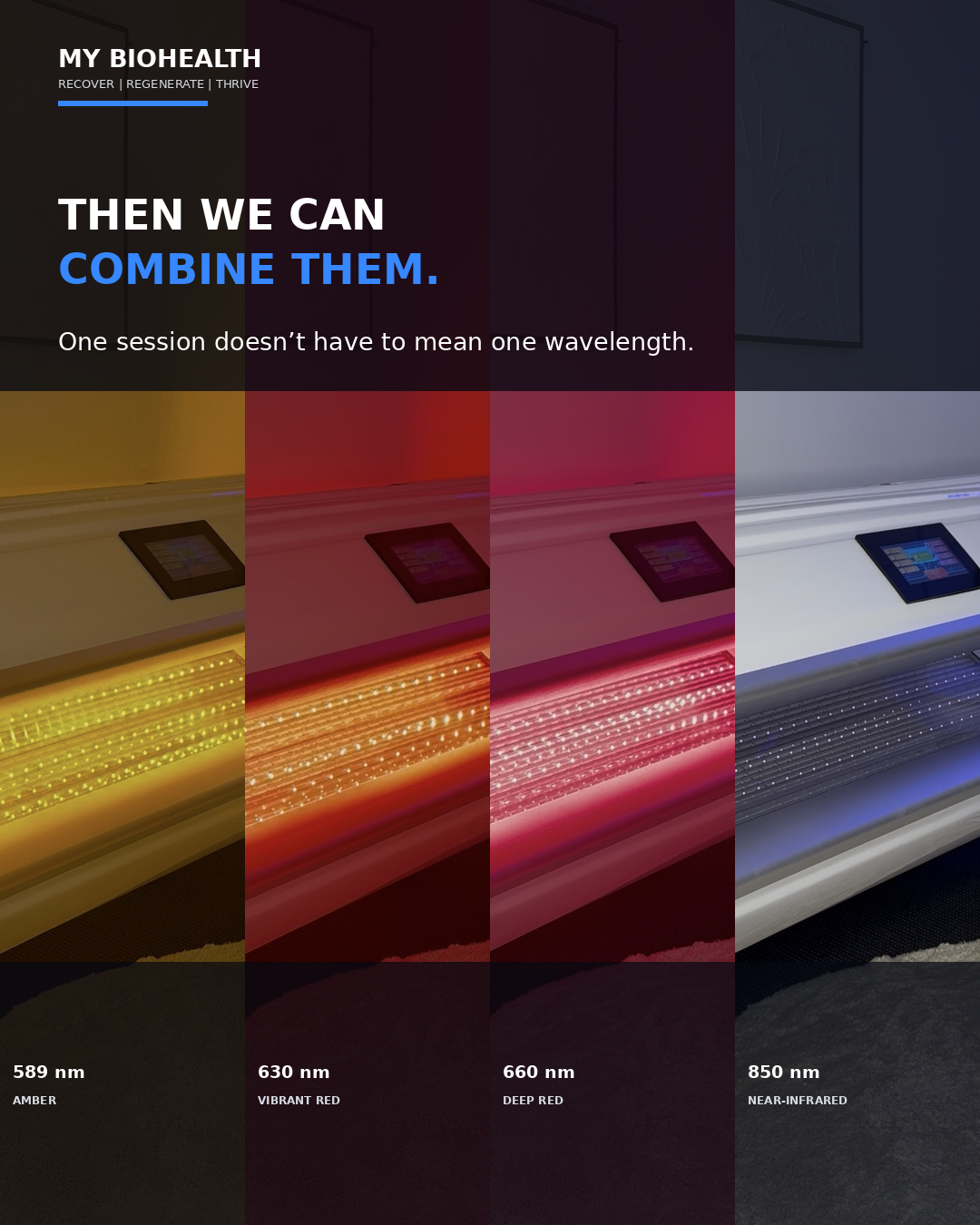
Our full-body bed includes visible amber light at 589 nm, visible red at 630 and 660 nm, and invisible near-infrared at 850 nm. There is overlap in how these wavelengths are researched: red and near-infrared both appear in skin studies as well as research on other tissues.
| Wavelength | Research context |
|---|---|
| 589 nm amber | Visible amber light, with skin-focused research at nearby wavelengths such as 590 nm. Device and protocol differences matter. |
| 630 nm red | Used in skin photobiomodulation research, including studies of skin appearance. |
| 660 nm red | Studied across skin, tissue and muscle applications, including facial-wrinkle research. |
| 850 nm near-infrared | Generally penetrates more deeply than visible red light and is studied in both skin and deeper-tissue applications. |
Wavelength alone does not establish how much light reaches a tissue or what a session will achieve. Device output, dose, exposure time, positioning and individual tissue characteristics all matter. A wavelength cannot establish that this bed targets internal organs or treats chronic pain.
Explore Understanding Red Light Therapy and photobiomodulation for the science, or our skin-focused wavelength guide for skin questions.
How light interacts with tissue
Tissues absorb and scatter photons differently according to wavelength. Cellular photoacceptors are molecules that respond to light; mitochondrial and cellular signalling pathways are among the mechanisms studied.
PBM research includes ATP, nitric oxide, reactive oxygen species and calcium signalling. These mechanisms help explain why PBM is studied, without determining what any individual session will achieve.
Read the PBM mechanism review and biphasic dose-response review or our Photobiomodulation Explained article.
Why penetration is not one fixed depth
Light intensity decreases as it is absorbed and scattered by melanin, haemoglobin, water and other tissue components. It does not stop at a single depth. A direct human-skin study found substantial attenuation of 850 nm light within the first millimetre; fixed claims such as “penetrates exactly 5 cm” oversimplify light delivery.
Read the human-skin penetration study and scar-study scoping review. Our wavelength illustrations show relative penetration, not a measured depth for this bed.
Red Light Therapy and HBOT
Some clients include both in a wider recovery plan. PBM uses light to interact with cellular signalling. HBOT changes oxygen availability while you breathe oxygen under increased pressure; My BioHealth offers mild-pressure HBOT sessions.
These are different physiological inputs. Evidence demonstrating an additional benefit from combining them is limited, so we do not claim a proven synergistic effect.
Explore Hyperbaric Oxygen Therapy at My BioHealth. Our wellness sessions do not replace hospital-based hyperbaric care.
Before your session
- Keep intended treatment areas uncovered; underwear can remain on.
- Arrive with clean skin, without makeup, lotion, oil or sunscreen on the areas being treated.
- Remove jewellery and watches.
- Wear the protective eyewear provided.
- Hydrate before and after your appointment.
Safety and suitability
Contact us before booking if you take medicines that increase light sensitivity; have skin cancer, melanoma or an undiagnosed lesion in the treatment area; have photosensitive epilepsy; are pregnant; have had a corticosteroid injection in the area within the last week; or have significant eye disease requiring advice about bright-light exposure.
Some antibiotics, isotretinoin and St John’s Wort are examples of medicines to disclose. Tell us about all medicines and relevant health conditions rather than relying on this list. Do not change prescribed medicines without advice from your prescriber.
This is a guide, not a complete screening list. Suitability varies, and medical or specialist assessment may be needed. Red Light Therapy should not replace appropriate care for symptoms that need investigation.
What does the research say?
PBM has a substantial research literature, with varying strength of evidence across devices, conditions and protocols.
A 2024 meta-analysis of 34 randomised trials reported benefits in muscle endurance and some recovery outcomes, with findings varying across populations. A 2025 meta-analysis found low-certainty evidence for reduced soreness when PBM was applied before exercise.
A 2025 whole-body PBM systematic review found no benefit for exercise recovery or performance biomarkers across five eligible studies, with a possible sleep-quality signal. Results from smaller localised devices should not be assumed to apply to a full-body bed.
A 2024 review in injured athletes reported pain-reduction findings without evidence of shorter return-to-play time. None of these reviews establishes a guaranteed result from your appointment.
Explore our Evidence Hub, the 2024 exercise meta-analysis and 2025 whole-body PBM review for the findings and limitations.
Red Light Therapy questions
Do I need to complete an assessment tool to book?
No. You can book directly online. Contact us first if a suitability concern applies or you would like guidance.
Does Red Light Therapy heat or burn skin?
You may notice bright light and gentle warmth. PBM does not use ultraviolet light and does not tan, burn or ablate skin. Temporary redness or sensitivity can occasionally occur.
How long is a session?
20 minutes in our full-body LED bed.
How much does it cost?
A single session is $59. Five-session packs are $266 and ten-session packs $502.
How many sessions should I have?
There is no universal schedule. Your goal, dose, area and response all matter. Your nurse can help you plan a suitable frequency.
Does more powerful light mean better results?
Not automatically. PBM has a biphasic dose response: too little light may provide insufficient stimulus, while excessive dosing may reduce the desired response. Wavelength, irradiance, energy dose, exposure time and frequency all matter.
Where is My BioHealth?
Unit 3, 11–13 Thompson Street, Campbellfield VIC 3061, in Melbourne’s north. Clients visit from Broadmeadows, Coolaroo, Roxburgh Park, Craigieburn, Glenroy, Fawkner, Thomastown and Lalor. Visits are by appointment.
Can I use NDIS funding?
My BioHealth is not an NDIS-registered provider. Self-managed or plan-managed participants should confirm whether the service is claimable under their individual plan with the relevant provider or plan manager before booking. Invoices and receipts are available on request.
Is the skin-focused page a different appointment?
No. It describes the same Red Light Therapy session and booking, with more detail on skin-related goals.
Explore related services
Ask us before your visit
Use our treatment enquiry form, call 0430 077 330 or email our team if you have a question about the session.
Book full-body Red Light Therapy
Twenty minutes of amber, red and near-infrared light in Campbellfield, Melbourne. Book a session for $59 or explore a five- or ten-session pack.
Questions about your goals
Can red light speed healing or fade a recent surgical scar?
Research results depend on the wound, device and dose, and are not consistent across studies. A full-body bed session cannot be assumed to reproduce a clinical wound protocol. Follow your surgeon’s advice and contact the team about suitability and timing before booking.
Search treatments & articles
Browse the links below. Typing search becomes available when this viewer allows scripts.
- Eyebrow Tattoo Removal in Campbellfield, MelbourneClinic information
- Private Infrared Sauna in Campbellfield, MelbourneTreatment
- Wellness & Recovery MembershipsClinic information
- Privacy PolicyClinic information
- Photobiomodulation ExplainedArticle
- Wellness, Recovery, Skin & Hair in Melbourne’s NorthClinic information
- Pelvic Floor EMS Chair Sessions in Campbellfield for Women and MenTreatment
- Full-Body Red Light Therapy in Campbellfield, MelbourneTreatment
- The Knowledge HubClinic information
- Skin & Hair FAQsClinic information
- Red Light Therapy for Skin in Campbellfield, MelbourneTreatment
- Magnesium Float Therapy in Campbellfield, MelbourneTreatment
- PRP & PRF Skin and Under-Eye Treatments in MelbourneTreatment
- Contact & Visit My BioHealthClinic information
- IV Therapy and InfusionsClinic information
- BioRePeel in Campbellfield, MelbourneTreatment
- HBOT Before PRP & PRF Hair TreatmentsArticle
- Fractional CO₂ Laser Skin Resurfacing in CampbellfieldTreatment
- Hyperbaric Oxygen Therapy (HBOT) in CampbellfieldTreatment
- Wellness, Recovery, Skin & Hair for CraigieburnClinic information
- Understanding Mitochondria & Cellular EnergyArticle
- Wellness & RecoveryClinic information
- Carbon Laser Facial in CampbellfieldClinic information
- Skin Needling & Microneedling in CampbellfieldTreatment
- PRP, PRF, ACP & ACP MAX ExplainedArticle
- Recovery Boots & Pneumatic Compression in CampbellfieldTreatment
- Hair Thinning vs Hair Shedding: What’s the Difference?Article
- Explore Your Skin OptionsClinic information
- Terms & ConditionsClinic information
- Your Recovery BlueprintClinic information
- PRP & PRF Hair Treatments in Campbellfield, MelbourneTreatment
- Understanding the EvidenceClinic information
- Skin, Hair & Regenerative TreatmentsClinic information
- Skin & HairClinic information
- Wellness & Recovery FAQsClinic information
- Hyperbaric Oxygen Therapy: What the Evidence ShowsArticle
- Functional Biomarker PanelClinic information
- Wellness, Recovery, Skin & Hair for Roxburgh ParkClinic information
- Advanced Treatment Options for Skin, Under-Eyes and HairTreatment
- Contact & Visit My BioHealthClinic information
- Wellness, Recovery, Skin & Hair for BroadmeadowsClinic information
- Pelvic Floor Health at Every Life StageArticle
- Laser Tattoo Removal in CampbellfieldTreatment
- Book your My BioHealth visitClinic information
- Book Skin & HairClinic information
- Wellness & Recovery Client ExperiencesClinic information
- Skin & Hair Client ExperiencesClinic information