
Pelvic Floor Chair Sessions for Women and Men in Campbellfield
Pelvic floor concerns can feel personal, and it can be hard to know where to start. Some people notice urine leakage when they cough, sneeze, laugh or exercise. Others have questions about pelvic-floor changes after pregnancy, during menopause, after prostate treatment, or about sexual wellbeing.
Pelvic-floor concerns can affect women and men at different stages of life. At My BioHealth in Campbellfield, our fully clothed, approximately 30-minute chair session uses electromagnetic stimulation to produce repeated pelvic-floor muscle contractions. The service is available to women and men. Book your pelvic health session online through Fresha.
What the pelvic floor does
The pelvic floor is a sling of muscle that supports the bladder and bowel and helps control continence. Women and men both have one. It can lose strength for many reasons, including pregnancy and childbirth, menopause, prostate surgery, ageing, chronic coughing, repeated heavy lifting and some high-impact activity. When it does, activities like coughing, sneezing, laughing or exercising can be accompanied by leakage.
Pelvic-floor muscle training is the usual starting point, and it is often taught and supervised by a pelvic-floor physiotherapist. A chair session is a separate, optional service that produces muscle contractions through electromagnetic stimulation rather than voluntary effort. It is not a replacement for that care.
Pelvic-floor health for women and men
Pregnancy, childbirth, menopause, prostate treatment, ageing, chronic coughing, repeated heavy lifting and some high-impact activity can all be relevant to pelvic-floor function. People notice different things: leakage when coughing, sneezing, laughing or exercising, changes after pregnancy, changes following prostate treatment, or questions about pelvic comfort and sexual wellbeing.
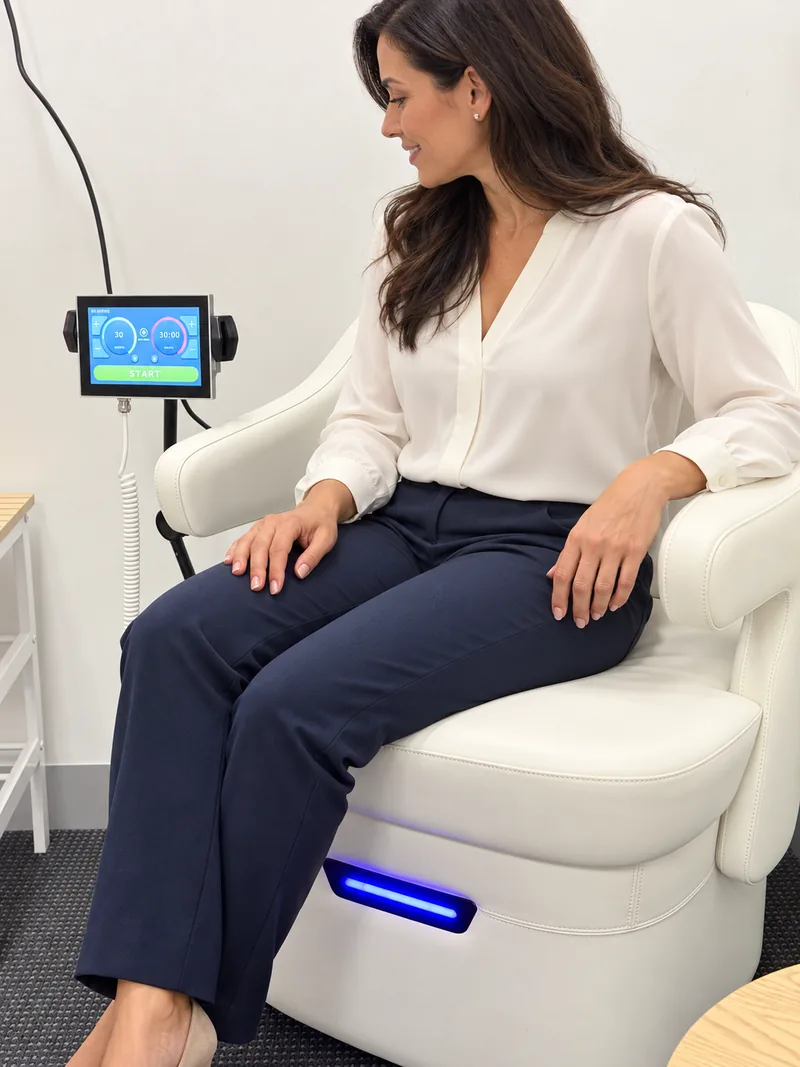
For women
Women often notice pelvic-floor changes around pregnancy and childbirth, during menopause, or with ageing. Leakage when coughing, sneezing, laughing or exercising is one of the more commonly described experiences.
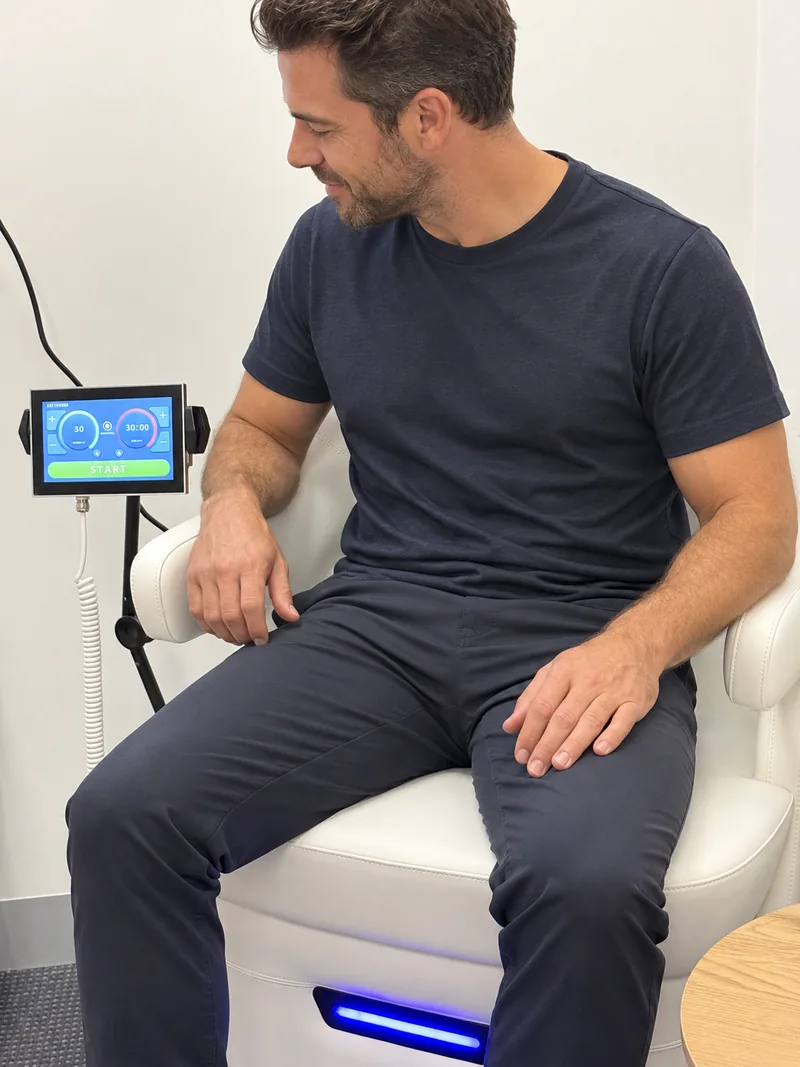
For men
Men often notice pelvic-floor changes with ageing or following prostate treatment, including changes in urinary control. It is the same chair session, in the same private room, booked the same way.
These symptoms can have different causes, and the cause matters. Persistent or concerning symptoms, including changes in urinary or bowel control and changes in sexual function, should be discussed with a GP, a pelvic-floor physiotherapist or an appropriate specialist. A chair session is an optional service and is not a treatment for those concerns.
Scarlett is our name for the pelvic-floor chair. It is the same session for everyone, in the same private room, booked through the same link.
About a chair session
The chair delivers electromagnetic stimulation that produces repeated pelvic-floor muscle contractions. The manufacturer describes this as High-Intensity Electromagnetic Technology (HIEMT). A session may support pelvic-floor muscle strengthening and urinary continence. Individual experiences vary and outcomes are not guaranteed. Sessions are around 30 minutes and completed fully clothed in a private room. You can book your pelvic-floor chair session directly online. Relevant precautions and suitability are checked with you at your appointment before the session begins. The chair is an optional service and does not replace pelvic-floor physiotherapy, GP care or specialist assessment.
What the research says
Research on electromagnetic pelvic-floor stimulation is developing. Studies use different devices, protocols and patient groups, so results from one study cannot predict an individual result or establish what another chair will do. We do not promise a particular change in urinary symptoms or sexual function.
When to seek assessment first
Please speak with your GP, a pelvic-floor physiotherapist or a specialist before booking if you have pelvic pain, prolapse symptoms, persistent urinary leakage, changes in bowel control, or symptoms following surgery. These need assessment, and a chair session is not a way to work out what is causing them.
For background on how the pelvic floor changes across different life stages, see .
Who it may suit
People book a chair session for a range of reasons. It may be worth a conversation if:
- You notice leakage when you cough, sneeze, laugh or exercise
- You have noticed pelvic-floor changes after pregnancy, during menopause, or following prostate treatment
- You have been advised to do pelvic-floor exercises and would like to discuss what else is available alongside them
- You are noticing changes with age and want to talk through your options
This is general information, not a diagnosis, and it is not a substitute for assessment. Whether a session is appropriate for you is decided in conversation with our nurses, and we will say so if assessment elsewhere is the better first step.
What to expect
Your first visit starts with a conversation. Our nurses will talk through what you are experiencing, answer your questions, and discuss whether the service may be suitable for you.
During a session, you sit on the chair fully clothed. Preparation is simple. Follow the clothing, food, hydration and metal-item guidance below before your appointment. A recovery period is not usually required, so you can continue with your day afterwards. There is no undressing and no internal examination.
Sessions are commonly delivered as a course, with the aim of supporting repeated pelvic-floor muscle activation. The number and spacing depend on your goals and suitability.
Why My BioHealth
We are a nurse-led clinic, so a chair session sits within a clinical conversation rather than being sold as an add-on. Relevant precautions are checked with you at your appointment, and we will encourage assessment with your GP or a pelvic-floor physiotherapist where that is the more appropriate first step.
Sessions and pricing
- Single session — $90
- 3 session package — $243
- 6 session package — $459
- 12 session package — $810
Sessions are completed fully clothed in a private room. Suitability is assessed before treatment.
Common questions
Most people describe a strong, rhythmic contraction sensation. The intensity is adjusted to your comfort during the session, and some people notice mild muscle soreness afterwards, similar to after exercise. You remain fully clothed throughout.
No. Pelvic-floor changes are not only related to pregnancy or childbirth. Ageing, menopause, prostate treatment, chronic coughing, repeated heavy lifting and some high-impact activity can all play a part, in people who have never been pregnant.
We cannot promise a specific outcome for any individual. Evidence for electromagnetic pelvic-floor stimulation varies by device, protocol and patient group, and this is general information rather than medical advice. What a session does is produce repeated pelvic-floor muscle contractions. Whether that helps you, and whether it is the right option at all, is something to discuss with our nurses and with your GP or pelvic-floor physiotherapist.
No, you remain fully clothed for the entire session. There's no undressing or internal examination involved.
Treatment is commonly delivered as a course of sessions where appropriate, with the aim of supporting repeated pelvic-floor muscle activation. The number and frequency of sessions will depend on your goals and suitability.
Most people return to their usual activities straight after a session. Individual responses vary.
No. The chair manufacturer’s manual says it should not be used by people with metal implants, pacemakers or stents. Tell our team about any implant or implanted device before booking so a nurse can discuss suitability with you.
No. The chair manufacturer’s manual lists pregnancy and breastfeeding as reasons not to use the chair. Let our team know so we can talk about timing with you.
Timing depends on your individual recovery, and the chair is not used while breastfeeding. Speak with your GP or our team about the right timing for your situation.
Your appointment starts with a private conversation about your goals and history, not a machine straight away. Relevant precautions and suitability are checked with you before the session begins, and we answer any questions honestly.
Yes, we're a short drive from all three, plus Coolaroo and Roxburgh Park. Because this service may be scheduled as a course of sessions, many local clients find the regular trip to Campbellfield straightforward.
The general terms are men’s pelvic-floor health and pelvic-floor muscle strengthening. A chair treatment may be described as electromagnetic or magnetic pelvic-floor stimulation, depending on the device.
Research has examined some sexual-function measures, but findings vary by device, protocol and patient group. We cannot promise a sexual-function outcome. Changes in sexual function should be discussed with a GP or appropriate specialist.
No. It is a separate service. A pelvic-floor physiotherapist or doctor can assess symptoms and recommend care suited to you.
Women and men can book a pelvic-floor chair session online through Fresha. It is one service, with the same session and the same booking link for everyone. Relevant precautions and suitability are checked with you at your appointment before the session begins.
What people commonly explore it for
- A private, fully clothed session in a private treatment room
- A non-invasive option that requires no undressing
- A clear starting point when you are unsure who to ask
These are reasons people book. Assessment with a GP or pelvic floor physiotherapist may be the better first step.
Preparing for your session
- Wear comfortable clothing without zips. You remain fully clothed throughout.
- Avoid a large meal just before your session. You will not eat or drink during the session.
- Remove all metal objects before your session, such as jewellery, belts, coins and keys.
- Tell your nurse about any implant or implanted device, any heart or circulation condition, pregnancy or breastfeeding, and any other medical treatment before your first session.
- Arrive well hydrated and rested.
Good to know
- Scarlett is our name for the chair. The manufacturer describes its technology as High-Intensity Electromagnetic Technology (HIEMT).
- Each session is 30 minutes. You stay fully clothed and simply sit on the chair throughout.
- A course of sessions is usually recommended rather than a single visit. The number of sessions is discussed with you.
- Some people notice mild muscle soreness afterwards, similar to after exercise.
Why My BioHealth
A private, fully clothed session in a nurse-led clinic. We will encourage assessment with your GP or a pelvic floor physiotherapist where that is the more appropriate first step.
Safety and precautions
The chair manufacturer’s manual says it should not be used if:
- You have a metal implant, such as plates, screws, pins or a joint replacement.
- You have a pacemaker or a stent.
- You are pregnant or breastfeeding.
- You have a severe cardiovascular or cerebrovascular condition (affecting the heart, blood vessels or blood supply to the brain).
Please contact our team before attending if:
- You have a skin infection.
- You have numbness or sensitivity issues.
- You are undergoing other medical treatment.
Can't find what you're looking for? Ask us directly and our team will get back to you.
This page is reviewed on a quarterly cycle. My BioHealth services are delivered within nursing scope of practice. Individual results vary and are not guaranteed. This page is general information only and does not replace individual medical advice.